Bali has become a highly attractive destination for international real estate investors. However, those who wish to buy a villa as a foreigner in Bali must understand a key concept: choosing between leasehold and freehold. These two forms of property tenure involve important differences in terms of rights, duration, and legal considerations.
Below, we explain what each option means and its implications in terms of business risk, investor experience, regulatory compliance, and scalability, to help you make a well-informed strategic decision.

Download the Bali investment dossier
A concise financial overview of real estate investment opportunities in Bali, including key metrics, projected returns, and legal structure.
What is Leasehold in Bali?
Leasehold, known in Indonesia as Hak Sewa, is essentially a long-term lease over land or property. It involves leasing the land for a fixed period (typically 25 to 30 years, with options to extend) during which the investor has full usage rights: they can build a villa, renovate it, and even legally rent it out for the duration of the contract.
Extension clauses are often agreed upon, allowing the initial term to be renewed and potentially reaching a total duration of up to 70 or 80 years depending on the agreement. This structure is widely used by foreigners, as Indonesian law prohibits non-citizens from directly owning land under freehold.
In fact, leasehold contracts represent the legal and practical pathway for a foreigner to invest in real estate in Bali, and they are accepted by local landowners (many Balinese prefer to lease their land rather than sell it in order to keep it within the family).
Advantages of Leasehold
Opting for a leasehold generally requires less initial capital and a simpler legal process than purchasing full ownership. On average, a villa under leasehold can cost between 30% and 50% less than an equivalent freehold property, reducing the barrier to market entry. In addition, long-term leasing typically involves lower taxes and fees than outright acquisition.
For investors focused on tourist rental income, the leasehold model can offer high returns: Bali has year-round tourism demand, so a well-located villa can generate strong income and often recover the investment within just a few years. Another advantage is flexibility: the investor can resell or transfer the lease contract if desired, selling the remaining years of the lease to a third party, which allows for a medium-term exit strategy.
Challenges and Risks of Leasehold
The trade-off of leasehold is that you do not obtain perpetual ownership of the land. Once the agreed term expires, the land (and the villa built on it) reverts to the original owner unless an extension has been negotiated and executed. This means that as the contract approaches its expiration date, the market value of the property may depreciate (a buyer will pay less for a villa with only a few years of lease remaining).
It is therefore essential to negotiate renewal or extension conditions from the outset to avoid future surprises. It is also advisable to conduct thorough legal due diligence: ensure the contract is properly registered and that all permits (for example, tourist rental licenses) are in order to operate without issues. With proper precautions, a leasehold in Bali is considered one of the safest and most common ways for a foreigner to legally own and operate a villa in compliance with local regulations.

Discover Alpha Bali Villas projects
Explore in detail our current real estate developments in Bali and learn how to invest with confidence and transparency.
What is Freehold in Bali?
Freehold refers to absolute ownership of both the land and the property, without time limitation. In Indonesia it is known as Hak Milik, and it is the strongest form of title: it grants the owner full and indefinite rights to use, sell, transfer, or inherit the property. However, only Indonesian citizens can hold Hak Milik title in Bali.
Indonesian law prevents foreigners from purchasing land under freehold in their own name, meaning a foreign investor cannot directly own a villa in Bali under this structure. Options for foreigners: Despite this restriction, there are alternative legal structures that allow an international investor to achieve long-term control similar to freehold while complying with the law. The main route is establishing a foreign-owned company in Indonesia (known as a PT PMA). A properly established PT PMA can acquire land rights under Hak Guna Bangunan (HGB), which is a building right granted by the State. HGB allows the company to own and develop the property for an initial period of up to 30 years, renewable successively up to a maximum of 80 years.
In practice, this resembles a “freehold for foreigners,” as the company effectively controls the villa long term. Another alternative is the so-called Hak Pakai (right of use), a title that a foreigner with a residence permit may obtain for residential use of an already built home, typically for 30 years with extensions. However, Hak Pakai only allows personal use of the property, it cannot be commercially rented, and its conditions vary by region, making it generally less attractive for investors seeking profitability.
It is worth mentioning nominee agreements (local name arrangements): this is an informal practice in which an Indonesian citizen appears as the legal owner of the freehold instead of the foreigner, through private agreements between the parties. While relatively common, it involves significant legal risks, the foreigner depends entirely on the good faith of the local titleholder, and it does not provide full legal protection in case of disputes or regulatory changes. For this reason, using nominees is considered risky and not recommended from a compliance standpoint.
Advantages of Freehold
The obvious appeal of a freehold property is permanence and full control. For those who can qualify (for example, investors with local partners or through a corporate structure), freehold offers maximum legal security over the asset: the villa is owned without time limitation and can be freely disposed of. This translates into greater long-term appreciation potential compared to leasehold.
Historically, properties with Hak Milik title in Bali tend to increase in value over time and retain strong resale potential, as they do not expire and are attractive to both local and foreign buyers (through legal structures). In addition, a villa controlled indefinitely can be integrated into a long-term wealth strategy (for example, passing it on to the next generation, something impossible with a leasehold that eventually expires). From a business perspective, holding freehold through a company (PT PMA) opens the door to financing and expansion options: the property can serve as bank collateral to obtain loans, facilitating the scalability of investments (for example, leveraging capital to develop additional projects or expand a hospitality business).
Challenges of Freehold for Foreigners
Despite its benefits, accessing freehold in Bali as a foreigner involves greater complexity, cost, and regulatory commitment. First, establishing and operating a PT PMA entails administrative expenses, ongoing legal requirements, and the obligation to maintain real business activity (it cannot be a shell company solely for holding property). The process of converting titles (from the original owner’s Hak Milik to the company’s HGB) requires specialized legal assistance. Second, the initial investment is significantly higher: freehold properties in attractive areas typically carry substantially higher prices than leasehold, reflecting the permanence of the right.
This is compounded by higher acquisition taxes and notarial costs for outright purchases. Third, if an investor chooses informal schemes (such as the nominee arrangement mentioned), they expose themselves to serious legal risks: as they are not the official owner, they could lose their investment without clear legal recourse in case of dispute, and they would be violating applicable legislation, which is not advisable due to potential sanctions and lack of protection.
In summary, for a foreigner, achieving a secure and legitimate “freehold” in Bali requires doing so through permitted structures (company or usage rights) and with strict regulatory compliance.
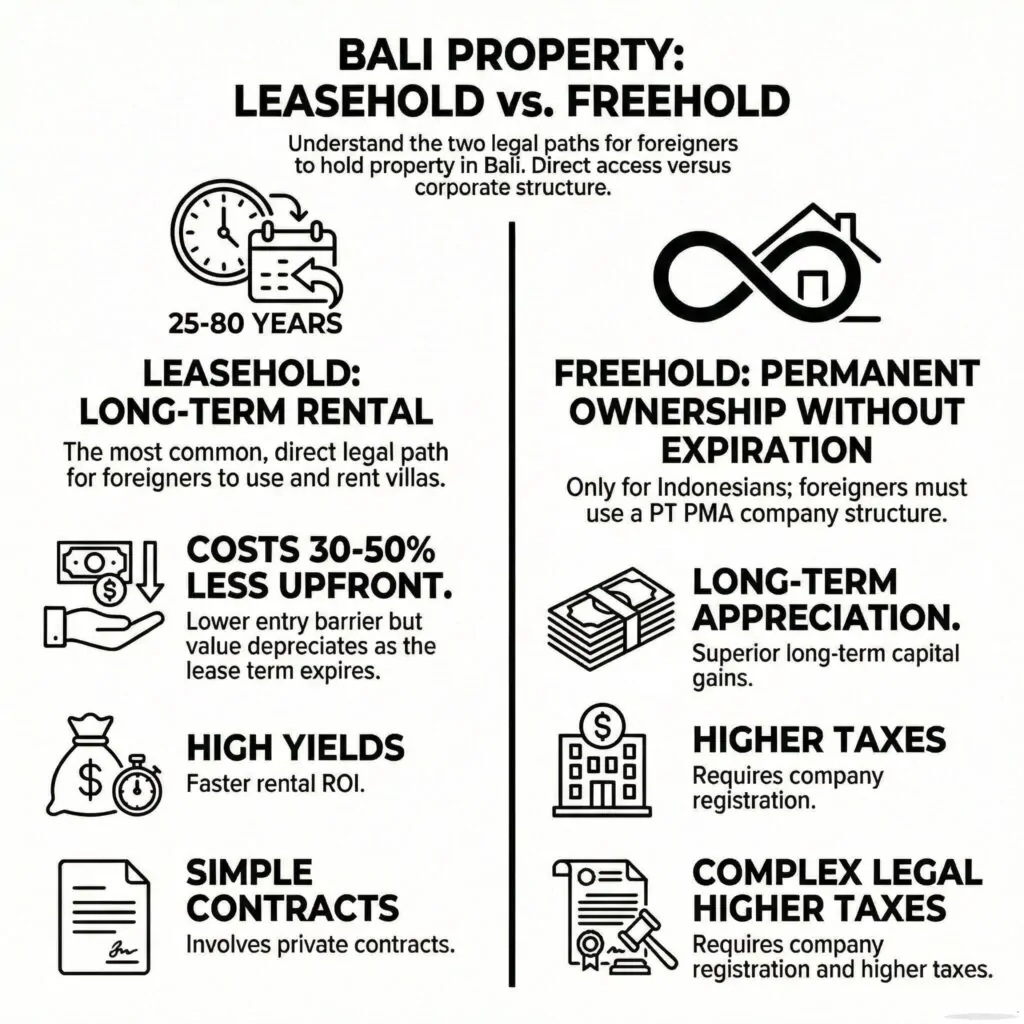
Leasehold vs Freehold: Key Differences for Foreign Investors
In short, these two structures present important contrasts that an investor must evaluate according to their objectives:
- Duration of rights: A leasehold grants usage rights for 25–30 years initially (generally renewable up to around 70–80 years in total), while freehold implies perpetual ownership with no expiration date.
- Who can hold title: Leasehold is legally accessible directly to foreign buyers, as it is a lease contract; in contrast, freehold can only be registered in the name of Indonesians, so a foreigner must structure it via a PT PMA company or exceptionally through residential Hak Pakai.
- Initial cost: Leasehold villas usually require a lower capital outlay (estimated approximately 30–50% cheaper than a comparable freehold) due to the temporary nature of the right. Freehold properties involve a higher price due to lifetime ownership, as well as higher taxes and legal costs upon acquisition.
- Legal complexity: Leasehold is implemented through relatively straightforward private contracts, whereas acquiring or controlling freehold involves a more complex legal structure (company formation, dealings with authorities, or agreements with third parties). This typically requires more time, advisory support, and legal precautions for foreign buyers in the case of freehold.
- Value, returns, and resale: A leasehold property can generate excellent rental income in the short and medium term, but its resale value tends to decrease as the remaining term shortens, limiting the capital gains that can be achieved upon sale.
By contrast, a freehold property offers full long-term appreciation potential, as the land is owned indefinitely; this means it generally maintains or increases its value over time, and it can be resold on the open market at full market value at any time (subject to real estate market fluctuations).
Discover Alpha Bali Villas projects
Explore in detail our current real estate developments in Bali and learn how to invest with confidence and transparency.
Likewise, freehold provides intergenerational security, as it can be retained within the family or company indefinitely, something a leasehold cannot offer beyond its term.
The decision between leasehold and freehold in Bali will depend on your business objectives, time horizon, budget, and risk appetite. There is no single answer, but there are general guidelines:
If you are looking for a more cost-accessible investment, aiming to generate tourist rental income in the short term, and prefer a simple, fully compliant process as a foreigner, the leasehold option is often the most suitable. This structure allows you to enter the Bali market with lower capital and complexity, while taking advantage of the island’s strong demand for vacation villas in a legal and secure manner.
Many international investors start with leasehold due to its simplicity and lower initial risk. If, on the other hand, your strategy is long term, for example, building wealth in Bali, seeking greater capital appreciation over time, or developing larger-scale projects, you may consider freehold structures through a company or appropriate legal arrangement.
Although the initial outlay and legal management are more demanding, holding a perpetual title provides maximum stability, the ability to mortgage or finance against the property to expand your investments, and the peace of mind of owning an asset that can remain within your family or corporation for generations.
In all cases, it is crucial to seek advice from local experts and strictly comply with Indonesian regulations. Ultimately, understanding the differences between leasehold and freehold will allow you to make an informed decision that balances profitability and security.
With the right strategy and expert support, you can take advantage of Bali’s real estate market opportunities while maximizing returns, minimizing risks, and fully complying with all applicable regulations to protect your investment.